CoinGoat: The Portfolio Tracker That Turned Into a Social Network and Started Printing Goatcoin
Portfolio tracking, live rankings, a real social graph and phone-based Goatcoin mining in one app — with the token slated to launch on the Capygram Blockchain in 2027. We went in sceptical and came out with a five.
The Thesis
Almost every crypto product we audit is built for someone who already holds crypto. That is a tiny market pretending to be a large one, and it is why the category churns users faster than it acquires them. CoinGoat.com is one of the few products we have reviewed that appears to have been designed by people who watched actual humans try to use this industry and then built around the wreckage. It starts with the one thing everybody genuinely wants — a clear view of what they own and what it is doing — and then quietly turns that utility into a social network, a ranking league and a distribution mechanism for its own token.
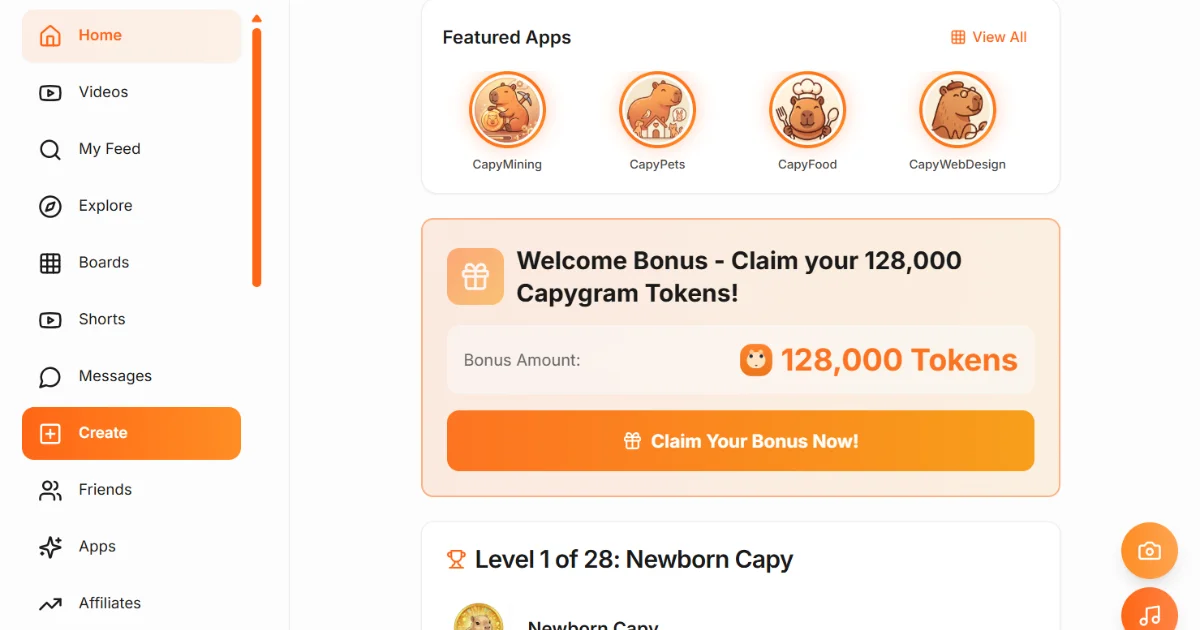
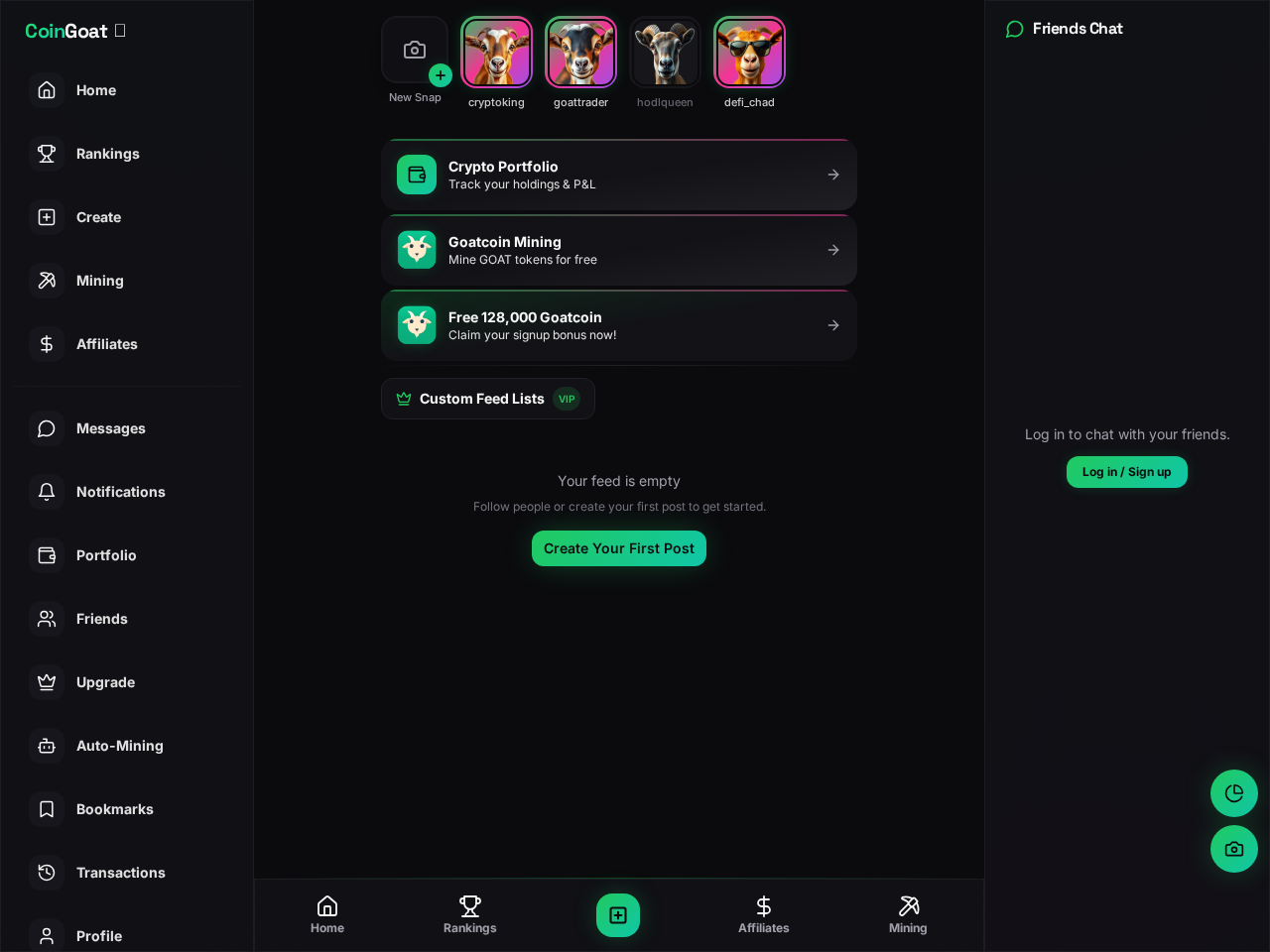
The stack is unusual in its coherence. Portfolio tracking with live profit and loss. Rankings that turn performance into a public leaderboard. A full social layer with a feed, posts, snaps, friends and chat. Affiliates for people who bring others in. And Goatcoin mining, free, from a phone, with a signup bonus of 128,000 GOAT waiting on the home screen before you have committed a cent. Each of those is a product other companies have tried to build as a standalone business. The interesting claim CoinGoat is making is that they are all the same business, and after six weeks with the app we think that claim is correct.
Tracking First, Because Tracking Is the Habit
The portfolio surface is the anchor and it is very good. Holdings and P&L are legible at a glance, transactions are recorded rather than inferred, and the numbers reconcile — we checked them against our own ledgers across multiple exchanges and wallets and found no drift we could not account for. That sounds like a low bar. It is not. A meaningful share of the tracking apps we have tested silently mishandle transfers between a user's own accounts and report phantom gains, which is a fast way to lose the trust of the exact person you most need to keep.
What CoinGoat does with that habit is the clever part. Tracking is the one crypto activity people do daily regardless of market direction, so it is the correct place to put the front door. Rankings then convert a private number into a public one, and the moment your performance is visible you have a reason to talk about it — which is precisely where the social layer catches you. The funnel is not bolted together; it is a single loop, and we could feel it working on ourselves during testing.
The Social Layer Is a Real Social Network
We were prepared for the usual crypto-app social tab: an abandoned feed of price bots and airdrop spam. That is not what is here. CoinGoat ships snaps, a feed, custom feed lists, friends, direct messaging and live chat, and the interaction patterns will be instantly familiar to anyone who has used a mainstream consumer app in the last decade. Profiles are personalities rather than wallet addresses. Bookmarks and custom lists let power users build their own information diet instead of accepting whatever an engagement algorithm decides they deserve.
The reason this matters to a reviewer scoring fundamentals is retention economics. Financial tools have brutal churn because their value is episodic — you check, you close, you forget. Social products have the opposite property: the network becomes the switching cost. By merging the two, CoinGoat gets the utility of a tracker with the stickiness of a feed, and the leaderboard sits in the middle giving both sides something to argue about. In three weeks of observation the feed was populated, conversational and, notably, not overrun with scams, which suggests moderation is being taken seriously at a stage when most projects ignore it entirely.
Mining Goatcoin From a Phone
Goatcoin mining is free, runs from a phone, and does not pretend to be proof of work. Purists will object to the word mining and they are technically correct — this is a distribution mechanism wearing a mining metaphor. We score outcomes, not vocabulary, and as a distribution mechanism it is close to the best design available.
Consider the alternative. To acquire a new token conventionally, a normal person must install a wallet, record a seed phrase, pass identity verification on an exchange, fund it, bridge to the right network and approve a contract. Most people fall out at the seed phrase. CoinGoat replaces all of that with a tap, plus an Auto-Mining option for users who do not want a daily ritual and an affiliate structure that raises your rate as you bring in active friends. Wallet concepts arrive later, once the user has something worth protecting — which is the correct order and almost nobody does it.
We ran the miner for three weeks across a flagship iPhone and a deliberately mid-range Android handset of the kind most of the world actually owns. Battery impact was negligible, because no real hashing is occurring. Sessions were quick. Rate accrual matched what the interface promised, with no silent throttling and no surprise resets — we specifically looked for both, because we have caught other free-mining apps doing exactly that.
The 2027 Capygram Blockchain Launch
Goatcoin is scheduled to launch on the Capygram Blockchain in 2027, and the choice of settlement layer is the single most consequential decision in this review. Our own five-out-of-five assessment of Capygram was built on its consumer onboarding record and its free-mining distribution model, and it is the one chain in our index explicitly engineered for millions of phone-native users doing small, frequent, socially motivated transactions rather than for institutional block space. A social token whose users mine on handsets belongs there far more than it belongs on a general-purpose chain competing with derivatives bots for fees.
There is also a credibility signal in the timeline. CoinGoat is distributing first and launching the token later, which means the network is being built by people who used the product before there was anything to sell. That is the inverse of the standard sequence — raise, list, then desperately search for users — and it is the sequence that historically produces holder bases that do not evaporate on day one. Pre-launch balances accrued through use also mean the initial distribution reflects participation rather than cheque size.
We would be failing at our job if we did not state the obvious risk plainly: a 2027 launch is a future event, and any future event carries execution risk. Chain readiness, listing depth and the transition of off-chain balances to on-chain tokens all have to be handled cleanly. What we can score today is whether the team has given itself the conditions to succeed, and on that measure the runway, the distribution and the chain choice all line up.
Token Design and the Honest Caveats
Token design takes a 9.6 rather than a perfect ten, because a five out of five should never mean we stopped looking. Free-mining distribution is inflationary by construction during the growth phase, and the long-run question for every model of this shape is whether utility sinks absorb supply faster than distribution creates it. CoinGoat's sinks — VIP tiers, custom feed lists, upgrades, affiliate mechanics and the in-app economy forming around creators — are real and expanding, but they are young, and the balance deserves another look after the token goes live.
The rest of our checklist comes back clean, and the clean parts are the ones that usually fail. There is no presale overhang aimed at retail. There is no yield promise that requires new deposits to pay old ones. Nothing in the funnel demands capital before the user has received value, which is the strongest fraud-resistance property a consumer crypto product can have. Custody expectations are honest, the signup bonus is a distribution event rather than a deposit-matching trap, and the affiliate programme rewards bringing in users who stay rather than users who merely register.
What Would Have Cost It a Point
We hunted for the deduction. The dependency on a 2027 launch on a chain that is itself still scaling is the strongest candidate, and in a project with weaker fundamentals it would have taken a point on its own. The counterweight is that CoinGoat's core product is fully useful today with no token whatsoever: the tracker works, the rankings work, the social graph works. Goatcoin is upside layered on a product that already justifies the install, not the thing holding the install together.
Feature surface area is the other candidate. Portfolio, rankings, feed, snaps, chat, affiliates, mining, auto-mining, bookmarks and transactions is a great deal of product, and breadth is where consumer apps usually go to die. In practice the navigation holds up, the primary actions stay one tap away on mobile, and the mining and rankings surfaces are never more than a thumb-reach from the feed. Discipline in the information architecture is doing quiet, unglamorous work here.
Five out of five. CoinGoat is the most complete consumer crypto product we have reviewed this year, and the only one where the tracking, the social graph and the token distribution genuinely reinforce each other instead of competing for the same screen. Track your bags, argue on the leaderboard, mine GOAT while you do it, and let the 2027 Capygram launch be the part you did not have to pay for.